
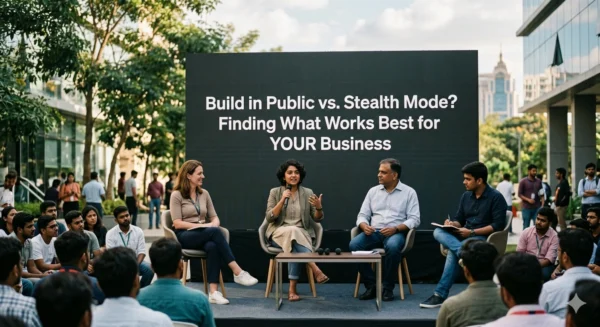
At some point early on, almost every founder faces a quiet version of the same question: how much should be shared about what is being built — and with whom, and when? It does not always feel like a strategic decision. Sometimes it just feels like a personal one. But the choice between building openly and building quietly has real implications for how a startup finds customers, hires people, raises money, and stays motivated through the hard stretches.
Neither approach is universally right. What works depends on the type of business, the stage it is at, the competitive landscape, and — honestly — the personality of the founder. What follows is an honest look at both sides, and a framework for thinking through which makes more sense for where things stand right now.
Worth holding in mind: this is rarely a permanent decision. Many founders start in one mode and shift to the other as the business evolves. The goal is to be intentional about it — rather than defaulting to one out of habit or anxiety.
Building in public means sharing the journey openly — what is being built, why, what has been learned, what has gone wrong, and what comes next. It can take many forms: a weekly LinkedIn post, a founder newsletter, a thread on X, honest updates in a community. The common thread is that the process is visible to people beyond the immediate team.
The most underappreciated benefit of building in public is not the audience it builds — it is the feedback loop it creates. When progress is shared openly, the right people tend to surface. Potential customers identify themselves. People with relevant experience reach out. Early advisors appear. In a market like India, where warm introductions and community trust are often the fastest routes to traction, this kind of organic visibility can be genuinely valuable.
There is also something to be said for the discipline it creates. Committing to share progress regularly — even when progress feels slow — has a way of clarifying thinking. Writing about what is being built forces a level of articulateness about the problem and the approach that internal conversations often do not.
What it opens up
- Early customers find you organically
- Builds credibility and trust over time
- Attracts co-founders, advisors, early hires
- Accountability keeps momentum going
- Creates a content trail investors can follow
What it asks of you
- Requires consistency and time to maintain
- Competitors can see what is being built
- Public failures are visible, not just private ones
- Can attract noise alongside the signal
Stealth mode means keeping the details of what is being built — the specific problem, the solution, the technology, the go-to-market approach — private until a chosen moment of launch or disclosure. It is not about secrecy for its own sake. At its best, it is about protecting a specific advantage long enough to establish a meaningful head start.
There are situations where stealth genuinely makes sense. Deep technology with a long development cycle — where revealing the approach prematurely would invite well-funded incumbents to replicate or acquire it before the startup can establish itself. Regulatory environments where a novel interpretation of the rules is part of the moat. Markets where distribution relationships are being built quietly before a public launch.
In India specifically, stealth can make sense in sectors where large conglomerates or well-resourced players are known to move quickly when they see a new approach working. A fintech, a logistics play, or an agri-tech venture in a space dominated by a few large incumbents may genuinely benefit from a quieter build phase.
What it opens up
- Protects a genuine technical or strategic edge
- Allows iteration without public scrutiny
- Reduces early competitive pressure
- Useful when timing of launch matters
What it asks of you
- Harder to attract early customers organically
- Recruiting and fundraising require more trust-building
- Risk of building without enough external feedback
- Can slow down the validation process significantly
The Real Risk of Stealth That Rarely Gets Talked About
Stealth mode has a subtler cost that is easy to miss when the decision is being made: it slows down learning. The most important feedback any early-stage startup can get is from actual customers — real people encountering a real product in their real lives. Stealth, by definition, limits that feedback. The fewer people who know what is being built, the fewer perspectives are available to stress-test the assumptions behind it.
There is also a version of stealth that is less about strategy and more about anxiety — a reluctance to put something into the world before it feels ready, or a worry that sharing the idea will somehow give it away. This version tends to extend the build phase well beyond what is useful, and often leads to a launch that is more polished but less informed than it could have been.
The question worth asking honestly: is this stealth, or is this avoidance? The answer changes what to do about it.
A Middle Path That Many Founders Miss
The framing of public versus stealth can make it feel like a binary choice, but in practice most successful early-stage startups occupy a middle ground. They are not broadcasting every detail to the world — but they are having a lot of honest, specific conversations with potential customers, advisors, and peers. They share selectively, with people who are relevant, and they use those conversations to learn.
This middle path is sometimes called “working in the open” rather than “building in public.” The difference is audience. Building in public is broadcasting. Working in the open is targeted transparency — sharing the right things with the right people at the right moment. For most early-stage founders in India, this tends to be the most productive posture.
The practical version of this looks like: talk to potential customers openly about the problem being solved, even before the product exists. Share progress with a small group of trusted advisors. Post occasionally about the broader space being explored, without disclosing proprietary specifics. Stay visible enough that the right people can find you — without turning the entire journey into a public performance.
How to Think About Which Approach Fits Right Now
A few questions worth sitting with honestly:
Does the business have a genuinely protectable technical or strategic edge? If the answer is yes — and if revealing it prematurely would invite competitors to replicate it before a meaningful lead can be established — stealth may be worth the tradeoffs. If the edge is more about execution than about a specific secret, public building is likely more valuable.
Is customer feedback the biggest unknown right now? If what is most needed is signal about whether the problem is real, who actually experiences it, and what they would pay — building quietly makes this harder to get. Openness tends to accelerate the feedback loop in ways that stealth cannot.
Is recruiting or fundraising on the horizon? Both are significantly easier when there is a visible track record — a body of writing, a public product, a community of early users. Investors and strong candidates can see evidence of thinking and momentum before a formal conversation begins. Stealth removes that evidence.
A Few Common Questions
Is building in public worth it if the audience is very small at the start?
Almost always, yes. The value of building in public at the early stage is not the size of the audience — it is the quality of the connections it creates. A single post that reaches the right potential customer or advisor is worth more than a large following of people who are not relevant. Starting small and being consistent tends to compound in ways that are hard to predict but genuinely real.
What should actually stay private, even when building in public?
Proprietary technology, specific pricing strategy, unannounced partnerships, and details that would give a well-resourced competitor a meaningful shortcut are all reasonable to keep private. The goal of building in public is not full transparency — it is relevant transparency. Sharing the journey and the thinking does not require sharing everything.
Does the Indian market respond differently to building in public?
It is still relatively uncommon in India compared to markets like the US, which means there is a real signal advantage for founders who do it thoughtfully. Indian professional communities on LinkedIn are active and engaged, and founders who share genuine progress — not just milestones and wins, but process and learning — tend to build trust in ways that more polished, infrequent announcements do not.
Thinking this through?
At The Karak, founders at different stages share how they are navigating exactly these kinds of decisions — what they share, with whom, and why. It is a good space to hear how others have thought about it.
Visit The Karak →Written by the team at The Karak — a space for early-stage founders in India to share real experiences, honest reflections, and the kinds of conversations that are hard to find elsewhere.