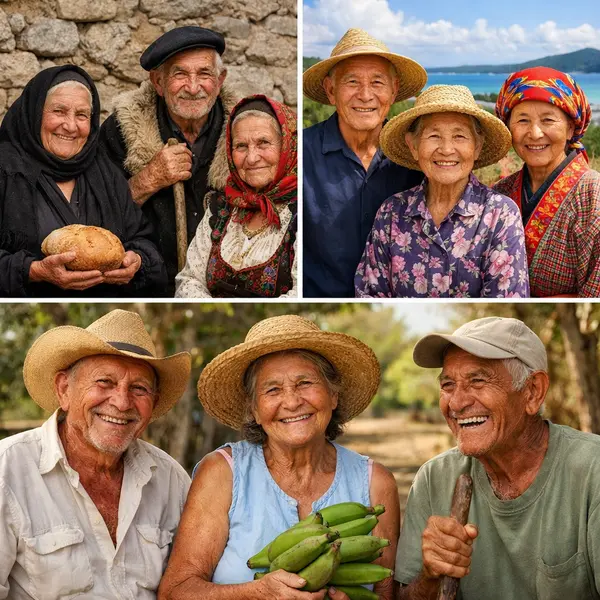

Why do some people simply forget to grow old?
In the mountain villages of Sardinia, on the island of Okinawa, and in the sun-baked peninsula of Nicoya, ordinary people are reaching their hundredth year without fanfare — still gardening, still laughing with neighbours, still waking with purpose.
It was this puzzling phenomenon that captured the imagination of explorer and journalist Dan Buettner in the early 2000s. Funded by National Geographic and the National Institute on Aging, Buettner assembled a team of demographers, epidemiologists, anthropologists and medical researchers and set out to do something almost audaciously simple: reverse-engineer longevity.
The result was one of the most widely discussed frameworks in modern health science — the Blue Zones — a concept that has since spawned Netflix documentaries, New York Times bestsellers, and real public-policy changes across dozens of American cities. It has also attracted serious, pointed criticism. What follows is a balanced account of what Buettner found, what science supports it, and where the debate stands today.
 Ogimi village, Okinawa — home to some of the world’s longest-lived women and the birthplace of ikigai
Five Places Where the Clock Runs Slower
After combing through global census data, Buettner and his team identified five geographically distinct regions — and drew blue circles around each on the map. These became the Blue Zones.
Home of the World’s Longest-Lived Women
Okinawan centenarians — predominantly women — are shaped by a plant-forward diet rich in sweet potatoes, tofu, and bitter melon; deeply rooted social groups called moai that provide lifelong emotional and financial support; and the philosophy of ikigai — a reason to wake up each morning. Physical movement is woven organically into daily life, not scheduled at a gym.
Where Men Reach 100 at Remarkable Rates
The mountainous Barbagia region of Sardinia boasts the world’s highest concentration of male centenarians. Sardinians drink moderate amounts of locally produced Cannonau wine — rich in polyphenols — eat primarily whole grains, legumes, and garden vegetables, and maintain multigenerational households where elders remain central to family life.
The World’s Lowest Rate of Middle-Age Mortality
Nicoyans hold the belief of plan de vida — a life plan, a reason to be. They eat simple, local food: tropical fruits, black beans, maize tortillas. Their days are structured around hard physical work, strong faith, and family. Research has linked Nicoyan blood samples to measurably longer telomeres — biological markers of cellular youth.
The Island Where People Forget to Die
Residents of this Aegean island have roughly 20% lower rates of cancer, 50% lower rates of heart disease, and near-zero dementia compared to the American population. They sleep late, nap regularly, eat a strict Mediterranean diet, tend gardens into old age, and socialise with near-daily intensity.
America’s Longevity Outlier
A tight-knit community of Seventh-Day Adventists, Loma Linda residents live roughly a decade longer than the average American. They observe a weekly 24-hour Sabbath, follow a largely plant-based diet, exercise regularly, and maintain strong faith-based social networks. It is the only Blue Zone in the developed world.
 The rugged mountain villages of Sardinia’s Barbagia region — home to the world’s highest concentration of male centenarians
The Power 9: Nine Habits of the Long-Lived
Across all five zones, Buettner’s team identified nine shared lifestyle factors. No single factor is revelatory in isolation — the magic lies in their quiet, unconscious accumulation over a lifetime.
 Legumes, whole grains, olive oil, and seasonal vegetables — the quiet architecture of a long life
What Independent Research Says
One of Buettner’s most important contributions is his insistence on cross-referencing Blue Zone findings with the broader scientific literature. The alignment is striking.
Diet: The Mediterranean Evidence
A landmark 2024 Harvard-led study tracking over 25,000 women for up to 25 years found that close adherence to a Mediterranean diet was associated with up to a 23% lower risk of all-cause mortality. The study — published in JAMA Network Open — found biological changes consistent with reduced cardiovascular disease and cancer risk. Researchers also found the diet was linked to measurably longer telomeres, chromosomal end-caps whose length is one of the most reliable biomarkers of cellular ageing.
Purpose: The Ikigai Effect
Buettner’s claim that having a sense of purpose adds up to seven years of life expectancy is backed by multiple independent studies. Research published in Psychological Science found that a stronger sense of purpose was associated with lower mortality across age groups. The 90+ Study — a two-decade longitudinal project at UC Irvine — found that social engagement, faith attendance, and cognitively stimulating activities were among the most consistent factors distinguishing people who lived to 90 and beyond.
Social Connection: The Loneliness Epidemic
Perhaps no Blue Zones finding is more pressing today than the centrality of social ties. Research consistently associates loneliness with a mortality risk equivalent to smoking 15 cigarettes per day. The Okinawan practice of moai — forming social support groups in early childhood that persist for life — offers a structural solution to a crisis the modern world is only beginning to take seriously. In 2023, the US Surgeon General declared loneliness a public health epidemic.
Gentle Movement: The Anti-Gym Argument
Extensive exercise science supports the idea that prolonged moderate activity — walking, gardening, low-intensity labour — may be at least as beneficial for longevity as intense gym training. A major meta-analysis in the British Journal of Sports Medicine found that even 11 minutes of moderate activity per day was associated with a substantially lower risk of premature death.
Where Critics Draw Blood
Good science welcomes scrutiny. And the Blue Zones framework has attracted some of the most pointed demographic scepticism in recent years — some of it genuinely illuminating.
⚠ The Newman Challenge
In 2024, Dr Saul Justin Newman of University College London won the first-ever Ig Nobel Prize in Demography for research arguing that much of the extreme longevity data underlying Blue Zones is riddled with errors. His analysis suggested that the highest rates of reported supercentenarian status are best predicted not by healthy lifestyles, but by high poverty, absence of reliable birth records, and pension fraud incentives.
Newman cited several alarming precedents: In 2010, the Japanese government found that over 230,000 citizens recorded as centenarians were missing, dead, or unverified. In 2012, Greece discovered that 72% of centenarians claiming pensions were already dead. In Costa Rica, 42% of reported 99+ year-olds were found to have misstated their ages in the 2000 census.
Newman’s most pointed claim: despite Buettner’s portrayal of Okinawa’s sweet-potato-heavy diet as a pillar of longevity, Japan’s own nutritional surveys consistently show Okinawa to have the lowest vegetable and sweet potato consumption in Japan, and the highest body mass index.
The Correlation-Causation Problem
Critics have also raised methodological concerns about the research design. The zones were not identified through a systematic global survey — they were selected based on prior observation and anecdote, creating the risk of confirmation bias. Correlation is not causation. The fact that Blue Zone centenarians share lifestyle traits does not prove those traits caused their longevity.
The Socioeconomic Blind Spot
Sceptics have also pointed to the role of socioeconomic factors that Blue Zones may underweight. The Loma Linda Adventist community is notably prosperous relative to surrounding populations — and wealth, independent of lifestyle, is strongly associated with longer life.
The Defence
Buettner and his researchers have pushed back firmly. The Sardinian data — the most rigorously validated of all Blue Zones — was cross-checked with church archives, civil birth records, and genealogical reconstructions. A 2026 peer-reviewed study in The Gerontologist by demographers Steven Austad and Giovanni Pes reaffirmed the demographic validity of the core zones using multiple independent validation methods.
Moreover, even if precise ages of some centenarians are unreliable, Buettner’s defenders argue this does not undermine the framework’s core value: the Power 9 principles align robustly with decades of conventional medical research regardless.
From Observation to Policy
Perhaps the most underappreciated dimension of Buettner’s work is its ambition not merely to observe longevity, but to engineer the conditions for it.
Beginning with a pilot in Albert Lea, Minnesota in 2009, the Blue Zones Project worked with city planners, businesses, schools, and local governments to redesign public environments so that healthy choices became the path of least resistance. After just one year, participants added nearly 2.9 years to their average projected lifespan. Freeborn County jumped 34 places in Minnesota’s county health rankings.
The project has since expanded to over 75 communities across the United States, producing measurable double-digit reductions in obesity, smoking rates, and body mass index. Harvard nutritionist Walter Willett called the Albert Lea results “stunning.”
The underlying insight — radical in its simplicity — is that individual willpower is a limited and unreliable tool. People do not decide to be healthy; they drift into it when their environments make unhealthy choices incrementally harder. No centenarian Buettner interviewed had decided in midlife to overhaul their diet or exercise regime. They were simply swimming in the right current.
A Framework, Not a Formula
The diets across the five Blue Zones are actually quite diverse — from the soy-heavy Okinawan diet to the olive-oil-drenched Ikarian table to the bean-and-maize simplicity of Nicoya. There is no single “Blue Zone diet.” What unites them is less a list of ingredients than a set of relationships: with food (whole, seasonal, social), with movement (habitual, light, embedded), with community (deep, persistent, reciprocal), and with time (purposeful, unhurried, rooted).
The Longevity Paradox:
It Was Never a Secret
Dan Buettner’s most enduring contribution may not be his data. It may be his lens: the idea that the conditions for a long life are not clinical interventions or biohacking protocols, but the ordinary texture of a life lived well — in connection, in purpose, in motion, in moderation.
The debate over Blue Zones data quality is important and ongoing. But stepping back from the statistical trenches, a larger truth emerges.
Virtually every serious independent longevity researcher converges on the same broad prescription: eat predominantly plants, move your body regularly without obsessing over it, nurture deep relationships, find meaning in your days, and manage stress with deliberate rituals rather than willpower. This is not a revelation. It is, as some critics note with a hint of mockery, rather obvious.
But perhaps that is exactly the point. The most powerful health interventions in human history have tended to be the most mundane — clean water, sanitation, not smoking. The Blue Zones framework offers a contemporary version of that insight, dressed in the vivid clothing of human stories from sun-drenched islands and mountain villages. If it takes a Netflix documentary set in Sardinia to persuade someone to eat more beans and spend Sunday with their family, that seems, on balance, a worthwhile trade.
The deeper critique — that we are so desperate for a “secret” that we will project meaning onto flawed data — deserves to be taken seriously. Longevity science is a field prone to wishful thinking, and the blueberry, as Dr Newman drily notes, is not going to save anyone. What the Blue Zones research points toward, at its most honest, is not a magic diet or a miraculous island. It is the sobering observation that modern life — its isolation, its sedentariness, its purposelessness, its ultra-processed convenience — is quietly and systematically killing us. And that the antidote is, in the end, remarkably human.
This article draws on Dan Buettner’s Blue Zones research, findings from the National Institute on Aging, the 2024 JAMA Network Open Mediterranean diet study (Brigham and Women’s Hospital / Harvard), the 90+ Study (UC Irvine), Dr Saul Newman’s demographic research (UCL), and a 2026 peer-reviewed validation study published in The Gerontologist by Austad and Pes.
THE ART OF LIVING LONG · A RESEARCH-BASED FEATURE · MARCH 2026
Sources: Buettner, D. (2023). The Blue Zones Secrets for Living Longer. · JAMA Network Open (2024). Mediterranean Diet & Mortality. · Newman, S.J. (2024). Ig Nobel Prize in Demography, UCL. · Austad & Pes (2026). The Gerontologist. · Harvard T.H. Chan School of Public Health.