
The best time to start was yesterday. The second best time is now.
Most Indian founders get this part wrong. They dream of a polished app that does everything. They spend months — and lakhs — perfecting features no one asked for. Then they launch, and no one shows up.
A Minimum Viable Product is the simplest version of an idea that solves one real problem for real users. It is not a half-baked product. It is a learning machine. Build it fast, get it in front of customers, and let their feedback tell you what to build next.
The India advantage in 2026: 100,000+ DPIIT-recognised startups, cheap developer talent, UPI payments, and 900 million internet users. An MVP can be validated for under ₹5–10 lakh and launched in weeks. The ecosystem is stacked in a founder’s favour right now.
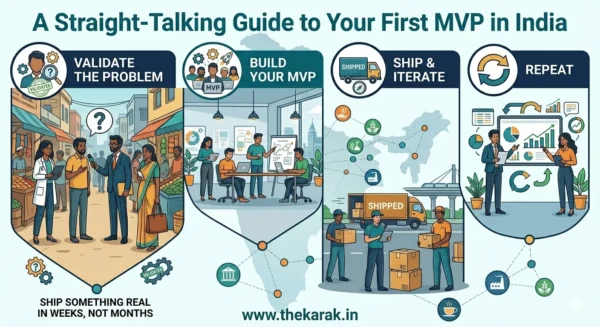
Before writing one line of code, answer this: what exact pain is being solved, and for whom? Sit with 20–30 potential customers — not surveys, but real conversations. Ask: “What’s the most annoying part of your day?” Record everything.
Use The Karak’s Startup Idea Validation Scorecard to score the idea on problem intensity, market size, and competition. If the score is low, kill the idea now. Save a year.
Local nuances matter in India. A solution that works in Bangalore may flop in Tier 2 towns because of language, data costs, or trust. Validate across metros and smaller cities. Spend 1–2 weeks here. Most successful Indian MVPs — think early Zomato or Paytm — started by solving one tiny frustration better than anyone else.
List every feature wanted. Then apply the “one core problem, one core solution” rule — keep only what delivers value in the first 5 minutes of use. If building a hyperlocal delivery app, the MVP is just: order → pay via UPI → track on map. No loyalty points, no AI recommendations, no dark mode.
A simple MVP canvas keeps this honest:
In 2026, being a coder is not a prerequisite for shipping a product. Three viable paths:
Bubble, Glide, or FlutterFlow. Ship in 2–4 weeks. Many Indian founders launched on Bubble for under ₹2,000/month. Best for founders who want speed over customisation.
Post on LinkedIn, Cutshort, or Twitter/X. A solid freelance team in Tier 2 cities — Indore, Coimbatore — costs 40–60% less than Bangalore rates. React + Node.js or Flutter.
Validate with no-code first. Rewrite in code once paying users exist. Most capital-efficient path if unsure about technical requirements.
Do not launch first and fix later. The government moves fast on penalties in India, and the compliance cost of doing this early is genuinely small compared to the cost of doing it late.
- Register as a Private Limited Company via the MCA portal — ₹7,000–10,000 with a CA. Sole proprietorship or LLP works for tiny tests but limits funding credibility.
- Get DPIIT Startup recognition — free, a 10-minute form on startupindia.gov.in. Unlocks a 3-year tax holiday, easier compliance, and government tender access.
- GST registration if turnover is expected to exceed ₹40 lakh (services) or ₹20 lakh (goods). Registering voluntarily even below threshold enables input tax credit.
- DPDP Act compliance — if collecting any personal data (email, phone, address), add a privacy policy, consent mechanism, and grievance officer. Fines start at ₹50 crore.
- Open a current account — IDFC FIRST or ICICI are consistently rated highest by Indian founders for startup-friendly features in 2026.
Use free tools where possible: Figma for mockups, Carrd for a landing page, Google Analytics and Hotjar for user tracking. Add one analytics event to start: “User completed core action.” That single metric will tell more than any dashboard.
Test on real Android phones — India is still 70% Android. Launch internally first, fix crashes, then soft-launch to 100 beta users via WhatsApp groups, LinkedIn, or Reddit (r/India, r/startupsIndia).
The MVP does not need to be beautiful. It needs to work and collect feedback. Polish is for Version 2.
Pick one channel where the target users already spend time — then go deep on that one channel before trying others.
- B2C: Instagram Reels, WhatsApp status, Product Hunt India
- B2B: LinkedIn posts and cold DMs to 50 specific prospects
- Hyperlocal: Facebook groups or community pages for the target area
Offer something real: “First 50 users get lifetime 50% off” or “Free for the first month.” Track one number obsessively — retention after Day 7. If people do not come back, the problem is not yet solved.
This is where real progress happens. Set up a simple feedback loop and run it every week without exception:
- In-app feedback form — Typeform or Google Form embedded in the product
- Weekly 15-minute calls with 5 users — calendar link, low friction, genuine curiosity
- Net Promoter Score survey sent every 30 days
- A public changelog — Indian users love transparency, it builds trust faster than any marketing
Kill features no one uses. Double down on what works. Most Indian unicorns pivoted 2–3 times after MVP feedback — Swiggy started as a restaurant discovery tool, nothing more.
After 4–6 weeks of real usage, ask the hard questions honestly:
- Are people paying — or showing strong, specific intent to pay?
- Is the acquisition cost sustainable given the revenue model?
- Are there product-market fit signals — 40%+ retention, organic shares, unprompted referrals?
If the answer is yes across all three — raise pre-seed or bootstrap to the next version. If the answer is no — pivot the model, narrow the segment, or shut down gracefully. Learning without wasting two years is the real win at this stage.
The ecosystem is genuinely stacked in a founder’s favour right now — low costs, massive market, and tools that let one person do what used to require a 10-person team. The only thing left is to stop planning and start building.
Validate one idea this week. Ship something imperfect by next month. The first 100 users are waiting.
Start with the Validation Scorecard
Before building anything, use The Karak’s free Startup Idea Validation Scorecard — a 20-minute exercise that tells exactly which assumptions still need testing before the first line of code is written.
Get the Free Scorecard →Written by the team at The Karak — a space for early-stage founders in India to share real experiences, honest reflections, and the kinds of conversations that are hard to find elsewhere.