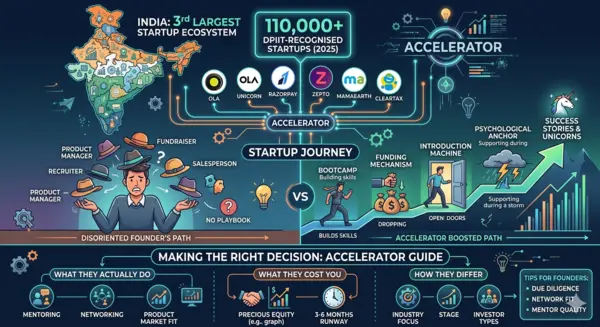

India is the world’s third-largest startup ecosystem, home to over 100 unicorns and more than 110,000 DPIIT-recognised startups as of 2025. Behind many of those breakout success stories — Ola, Razorpay, Zepto, Mamaearth, ClearTax — are startup accelerators: intensive, time-bound programs that compressed years of learning and network-building into weeks.
For a first-time founder, the startup journey is disorienting. You are simultaneously a product manager, recruiter, fundraiser, and salesperson, often with no playbook and no warm introductions into the rooms that matter. An accelerator is designed to change that. It is part bootcamp, part funding mechanism, part introduction machine, and part psychological anchor when things get hard.
But not all startup accelerators are created equal — and joining the wrong one can cost you precious equity and 3–6 months of runway. This guide is written specifically for the newbie founder who wants to understand what accelerators actually do, what they cost you, how they differ from one another, and how to make the right decision for your startup.
A quick note on terminology: in India the words ‘incubator’ and ‘accelerator’ are sometimes used interchangeably by the media and even by the programs themselves. This guide will clearly distinguish them where the distinction matters.
Section 1: What Is a Startup Accelerator?
1.1 The Core Definition
A startup accelerator is an intensive, fixed-duration program — typically 3 to 6 months — that provides early-stage startups with structured mentorship, seed funding, co-working space, curated workshops, and a powerful network of investors and industry leaders. The program almost always culminates in a Demo Day, where founders pitch to a room (or Zoom call) full of venture capitalists, angel investors, and corporate scouts.
The model was pioneered globally by Y Combinator in 2005. Today, India alone has over 1,000 accelerators and incubators, according to Tracxn, and they have collectively backed more than 7,400 companies.
1.2 Accelerator vs. Incubator — Know the Difference
This distinction is critical before you apply anywhere. The table below summarises the key differences:
| Dimension | Accelerator | Incubator |
| Stage focus | MVP to early traction | Idea / pre-product |
| Duration | 3–6 months (cohort-based) | 1–3 years (rolling admission) |
| Funding | Usually provides seed capital | Often does not fund; facilitates grants |
| Equity | 5–10% equity is standard | Often equity-free or nominal equity |
| Structure | Highly structured, milestone-driven | Flexible, founder-led timeline |
| Output | Demo Day pitch & VC introductions | Business plan, IP filings, early customers |
| Pressure | High-intensity, fast-paced | Lower pressure, exploratory |
| Best for | Founders with MVP & early validation | Founders at idea or research stage |
| Founder Tip: If you have just an idea and no product, look for an incubator first (IIM-A’s CIIE.CO, T-Hub’s incubation arm, or NSRCEL at IIM-B). If you have an MVP and some early users, an accelerator is likely the right next step. |
1.3 Types of Accelerators in India
The Indian accelerator landscape is not monolithic. Here are the main archetypes you will encounter:
Generalist / VC-backed Accelerators
Run by or affiliated with venture capital funds. They take equity and are hyper-focused on helping you raise your next round. Examples: Sequoia Surge, Antler India, Accel Atoms, 100X.VC.
Corporate Accelerators
Run by large companies to access startup innovation. They often offer non-dilutive funding or pilot contracts. The hidden value is distribution — the corporate becomes your first big customer. Examples: Microsoft for Startups, NASSCOM 10,000 Startups, Google for Startups, Cisco LaunchPad, Amazon Launchpad India.
Government / University-backed Accelerators
Funded or supported by the Government of India, state governments, or academic institutions (IITs, IIMs). These typically offer grants instead of equity, plus lab access, legal support, and IP filing assistance. Examples: IIMA Ventures (IIM-A), NSRCEL (IIM-B), FITT-IIT Delhi, T-Hub, WE Hub.
Sector-Specific Accelerators
Focused on a single vertical — fintech, agritech, climate tech, healthtech, or defence. They offer deep domain mentorship and curated investor introductions within that sector. Examples: YES FinTech (banking), Villgro (social impact / health), Bangalore Bioinnovation Centre (biotech), India Accelerator’s RUMS track (defence / space).
Non-Equity / Equity-Free Accelerators
A growing category especially important for first-generation founders who want to build without early dilution. Examples: WTFund (₹20 lakh non-dilutive for founders under 25), 1Mby1M (virtual, membership-based), some government TIDE 2.0 and AIC programs.
Section 2: What Do Accelerators Actually Offer?
Beyond the headline ‘seed funding and mentorship’, here is what you should realistically expect from a well-run accelerator program:
2.1 Seed Funding
Most Indian accelerators provide an initial cheque ranging from ₹10 lakh (government programs) to $3 million (Sequoia Surge). The median global deal sits at roughly $38,000 for 7% equity — a useful benchmark when evaluating term sheets. In India, the range is wider because you have both equity-free government programs and deep-pocketed VC-affiliated ones.
The funding is not the main event — it is runway. It buys you 4–6 months to build, test, and grow with structured support alongside you.
2.2 Mentorship Network
This is consistently cited by alumni as the single most valuable benefit. A top-tier accelerator plugs you into a network of 50–200 mentors: former founders who have scaled and exited companies, venture capitalists who see thousands of pitches, product and growth experts, legal advisors specialising in startup law, and CXOs from corporates. Done right, a single mentor introduction can unlock a customer, a hire, or a follow-on investor that changes your trajectory.
2.3 Workshops and Structured Curriculum
Good programs run structured sessions covering: product-market fit frameworks, go-to-market strategy, financial modelling, fundraising mechanics (cap tables, SAFEs, term sheets), hiring and culture building, legal compliance, pitch coaching, and media/PR. For a first-time founder with no business school background, this compressed curriculum is worth more than any MBA.
2.4 Peer Cohort
You are accepted alongside 8–30 other startups. These are your most honest mirrors. Cohort-mates share learnings, make introductions, collaborate on hiring, and provide psychological support during hard weeks. Many co-founder matches, first customers, and long-term business partnerships are born within accelerator cohorts.
2.5 Co-working Space and Operational Perks
Most programs provide free or subsidised co-working space, cloud computing credits (AWS, GCP, Azure — often worth $100,000+), legal retainers, accounting services, recruitment platform access, and SaaS tool credits. These ‘perks’ can save a seed-stage startup ₹20–50 lakh in its first year of operations.
2.6 Demo Day and Investor Access
The culmination of every accelerator program is Demo Day — a structured pitching event where your startup is presented to a curated audience of VCs, angels, family offices, and corporates. The best Demo Days (like those run by Sequoia Surge or Antler) generate term sheets within weeks. Even a mid-tier Demo Day gives you warm introductions that can take months to generate cold.
| Founder Tip: Do not judge an accelerator solely by its Demo Day attendee list. Ask alumni founders: ‘How many startups from your cohort raised within 6 months of Demo Day?’ That number tells the real story. |
Section 3: The Indian Accelerator Landscape — Key Players
Below is a curated overview of the most prominent accelerators operating in India as of 2025–26. We have grouped them by model to help you find your best fit.
3.1 VC-Affiliated Accelerators (Equity-Based)
Sequoia Surge (Peak XV Partners)
Arguably the most prestigious accelerator in India and Southeast Asia. Surge runs small, intimate cohorts (10–20 startups) and offers up to $3 million in seed funding. Founders get personalised mentorship from experienced Sequoia/Peak XV partners, access to the firm’s global LP network, and connections to alumni from the Surge community across India and Southeast Asia. Acceptance rates are extremely low. Surge also runs ‘Sequoia Spark’, a women-centric early-stage program, under the same umbrella.
Antler India
Part of a global pre-seed VC with presence in 30+ cities. Antler’s unique proposition is that it accepts solo founders and actively helps them find co-founders. It offers three tracks: Residency (for pre-idea founders), Fast Track (for teams with an MVP), and Before Day Zero (invite-only community). Antler commits up to ₹4 crores in investment and gives access to an 8,000+ strong global founder community and over 600 advisors.
Accel Atoms
A fast-track early-stage program from Accel India, one of the country’s most successful VC funds (Flipkart, Swiggy, Freshworks). Atoms provides capital, mentoring, and go-to-market guidance. The Accel brand gives portfolio startups significant credibility with downstream investors.
100X.VC
One of India’s most active pre-seed accelerators. 100X.VC invests through iSAFE notes (an Indian adaptation of the Y Combinator SAFE) and mentors startups at scale. They take a cohort approach and have backed over 200 startups across sectors.
Axilor Ventures
Founded by Infosys veterans (Kris Gopalakrishnan, S.D. Shibulal, and others), Axilor is Bengaluru-based and invests $500k–$750k in 8–12 startups per year. Over 75% of their portfolio companies receive follow-on funding — one of the highest rates in India.
Anthill Ventures
A global accelerator with deep Indian roots. Anthill focuses on Series A-ready startups and operates across India, the US, and Southeast Asia. They go beyond seed-stage support and offer a growth-focused curriculum aimed at startups that already have product-market fit.
India Accelerator
The only GAN (Global Accelerator Network) accredited accelerator in India, based in Gurugram. It runs a 16-week program and focuses on Robotics, Unmanned systems, Space (RUMS), energy, mobility, and GenAI. Startups get co-working space, cloud credits, legal/financial support, and introductions to India Accelerator’s global investor network.
Venture Catalysts (9Unicorns)
India’s most active seed investment platform, Venture Catalysts has backed over 110 startups since 2016. Its sister fund 9Unicorns is a dedicated accelerator fund. Both have a global footprint across India, Singapore, UAE, USA, and the UK. Their strength is a dense network of HNIs, family offices, and angel investors that provides deal flow even post-program.
3.2 Corporate Accelerators
Microsoft for Startups India
A non-equity corporate accelerator providing Azure cloud credits (up to $150,000), access to Microsoft’s sales and partner networks, enterprise customer introductions, and technical support. Particularly valuable for SaaS and AI startups targeting enterprise customers.
Google for Startups India
Offers Google Cloud credits, workspace tools, access to Google’s global mentorship network, and introductions to Google’s corporate development team. Google’s Accelerator India has specific tracks for women founders and underrepresented entrepreneurs.
NASSCOM 10,000 Startups
India’s flagship industry-driven startup initiative, backed by NASSCOM (the technology industry body). It has supported over 10,000 startups across India with mentoring, corporate connects, and co-working access. Particularly strong for B2B tech and enterprise software companies looking to land their first large corporate client.
T-Hub (Hyderabad)
India’s largest innovation ecosystem, T-Hub is backed by the Telangana government and a consortium of leading academic institutions. It runs both incubation and acceleration tracks, and has partnered with over 450 corporate and institutional partners. T-Hub’s strength is its bridge between Hyderabad’s pharma, defence, and IT sectors and early-stage startups.
3.3 University / Government-backed Accelerators
IIMA Ventures (CIIE.CO) — IIM Ahmedabad
One of India’s most respected academic accelerators. IIMA Ventures supports early-stage startups across three verticals: deep tech, climate/energy, and social impact. It has an extensive alumni network from IIM-A’s MBA programs and strong relationships with development finance institutions (DFIs) for impact-focused funding.
NSRCEL — IIM Bangalore
The startup hub of IIM Bangalore. NSRCEL runs multiple programs including a general accelerator, a women’s startup program, and a social innovation track. External founders (not just IIM alumni) can apply, making it accessible. NSRCEL alumni have collectively raised hundreds of crores in follow-on funding.
FITT — IIT Delhi
The Foundation for Innovation and Technology Transfer at IIT Delhi focuses specifically on deep tech — semiconductors, fabless chip design, biomedical devices, and advanced materials. The ‘FITT Forward 2025’ initiative is specifically designed to help researchers commercialise lab-scale innovations.
WE Hub — Telangana
India’s first state-government-run incubator exclusively for women entrepreneurs. WE Hub provides incubation, mentorship, funding connections, and market access to women-led startups across Telangana. It has expanded its remit as the state chapter of the Women Entrepreneurship Platform (WEP).
91springboard
A hybrid community and accelerator spread across multiple cities. 91springboard combines flexible co-working space with structured mentoring, workshops, and investor connect sessions. It is sector-agnostic and well-suited for early-stage founders who need a community before they need a formal program.
Section 4: The Economics of Acceleration — What It Really Costs You
4.1 Understanding Equity Dilution
Every equity-based accelerator takes a slice of your company. This is the price of admission. Standard terms in the Indian market range from 3% to 10%, though some early programs have historically taken as much as 15%. Here is how to think about this:
- If you join at a $500,000 valuation and give up 7% equity, you are effectively pricing your company and selling a stake.
- Future investors (Series A, B) will expect this stake to have been worth it — i.e., the accelerator materially accelerated your path to the next milestone.
- Giving up 7% to land a $3M Surge investment plus invaluable network is a very different trade than giving up 7% for ₹10 lakh and some workshops.
| Accelerator | Typical Cheque (USD) | Equity Taken | Key Value Add |
| Sequoia Surge | Up to $3M | Undisclosed | Brand, VC network, global scale |
| Antler India | Up to ~$50K | ~10–15% | Co-founder matching, global community |
| Accel Atoms | Undisclosed | Undisclosed | Accel network, GTM support |
| 100X.VC | $25K–$50K | ~7% (iSAFE) | Scale, repeat investor access |
| Axilor Ventures | $500K–$750K | Minority stake | Infosys network, follow-on funding |
| Techstars (Global) | $220K | ~5% + SAFE | Global network, corporate partners |
| Y Combinator (Global) | $500K | 7% | Brand signal, YC alumni network |
| Corporate (MS/Google) | Cloud credits | 0% | Enterprise access, pilot customers |
| Govt / University | Grants (₹10–50L) | 0% | IP support, academic credibility |
4.2 The Hidden Costs
Beyond equity, there are less visible costs that every founder should consider before applying:
- Time: A well-run accelerator program demands 40–60 hours per week of your attention. If you have paying customers, make sure you can balance both.
- Relocation: Many programs require physical presence in their city (Bengaluru, Hyderabad, Delhi NCR, Mumbai). Factor in rent, transport, and disruption to your existing team.
- Opportunity cost: The 3–6 months spent in an accelerator is time not spent shipping features, closing sales, or talking to customers. Make sure the trade-off is worth it.
- Cohort fit: A poor-fit cohort can be demoralising. If your peers are all B2C consumer apps and you are building enterprise SaaS, the peer learning value diminishes.
| Founder Tip: Before signing any term sheet with an accelerator, have a startup-experienced lawyer review the agreement. Pay particular attention to pro-rata rights (which allow the accelerator to invest in your next round), information rights, and any clauses about IP ownership. A good lawyer review costs ₹15,000–40,000 and is worth every rupee. |
Section 5: How to Evaluate and Choose the Right Accelerator
With over 1,000 programs in India alone, the choice is genuinely hard. Here is a structured framework for making the right call:
5.1 The Five Questions Every Founder Must Ask
Question 1: Does my stage match their focus?
Accelerators are stage-specific. Applying to a program that expects Series A-ready startups when you are still at MVP stage is a waste of everyone’s time. Read their portfolio carefully and look for startups at a similar stage of development to yours at the time they joined the program.
Question 2: Is there sector alignment?
A generic accelerator is fine for broad business fundamentals, but a sector-specific one gives you mentors who have already solved your specific domain challenges. If you are building in fintech, joining YES FinTech gives you access to regulatory expertise and banking partnerships that a generalist program cannot match.
Question 3: What is the track record?
This is the most important due diligence question. Ask: How many startups from the last three cohorts raised follow-on funding? Within how many months? How many have gone on to Series A? How many have shut down? A good accelerator will share this data proactively. If they are evasive, that is a red flag.
Question 4: Who are the mentors, and how accessible are they?
A list of 200 mentors on a website is marketing. What matters is how many mentors are active, how frequently they engage with cohort companies, and whether the accelerator manager takes accountability for connecting you to the right person. Ask alumni: ‘How many meaningful mentor sessions did you have, and did they lead to anything tangible?’
Question 5: What are the exact terms?
Get the term sheet before accepting any offer. Understand: the equity percentage, the pre-money valuation at which they are investing, pro-rata rights, information rights, any board seat requests, and what happens if you raise your next round quickly. Do not let excitement override diligence.
| The median global accelerator deal is $38,000 for 7% equity. Use this as your reference point. If an Indian accelerator is asking for more than 10% for less than $25,000 in funding, scrutinise the value add very carefully. |
5.2 Red Flags to Watch Out For
- Charging an application fee or program fee before offering you a spot.
- Vague or non-standard equity terms that are not comparable to market norms.
- No alumni network you can contact independently for references.
- Mentors who are not reachable or who only attend Demo Day.
- Programs that claim to be ‘sector agnostic’ but have no domain expertise in your vertical.
- Promises of guaranteed investor introductions without demonstrating existing relationships.
- Programs with no clear Demo Day or investor network outcome data.
5.3 A Decision Matrix for Newbie Founders
| Your Situation | Best Fit |
| Idea only, no product | Government incubator, NSRCEL, CIIE.CO, or AIC program |
| MVP built, no traction | Antler India, 100X.VC, India Accelerator, EvolveX |
| MVP + early revenue | Axilor, Accel Atoms, Venture Catalysts, Sequoia Surge |
| First-gen, non-metro founder | 1Mby1M, NASSCOM 10,000 Startups, AIC programs |
| Woman founder | WE Hub, Sequoia Spark, Google for Startups Women |
| Deep tech / research origin | FITT IIT Delhi, IIMA Ventures, Bangalore Bioinnovation Centre |
| Need enterprise customers fast | Microsoft for Startups, NASSCOM, Cisco LaunchPad |
| Defence / space / drones | India Accelerator (RUMS track), iDEX, AIC T-Hub |
| Social impact / agri / health | Villgro, IIMA Ventures, AIC-GUSEC |
Section 6: How to Apply — A Practical Playbook
6.1 Build Your Application Story
Every accelerator application has roughly the same structure: Problem, Solution, Team, Market, Traction, and Why Now. Here is how a first-time founder should approach each:
Problem
Be obsessively specific. ‘There is no good product for X’ is a weak problem statement. ‘Small kirana owners in Tier-2 cities lose ₹8,000/month because they cannot track expiry dates on perishables, and existing software costs ₹4,000/month’ is a strong one. Show that you understand the problem from the inside — that you have lived it or talked to dozens of people who have.
Solution
Explain what you have built or are building in plain language. No jargon. Show a demo if you have one. Accelerators fund teams as much as ideas, so your demo signals execution capability.
Team
This is often the deciding factor for early-stage programs. Explain why your team is uniquely suited to solve this problem. Domain expertise, prior relevant experience, complementary skills between co-founders, and evidence that you can execute under pressure all matter.
Market Size
Use credible sources and show your math. TAM (Total Addressable Market), SAM (Serviceable Addressable Market), and SOM (Serviceable Obtainable Market) — but more importantly, explain the bottom-up logic of how you will capture your first 1,000 customers.
Traction
Even if you have just 10 users or ₹50,000 in revenue, show it. Traction is proof that real people will pay for your solution. Even letters of intent from potential customers, or 500 beta sign-ups, can be meaningful at the idea stage.
6.2 The Pitch Deck
Keep your initial pitch deck to 10–12 slides. The structure that works: Cover → Problem → Solution → Market Size → Product (with screenshots or demo) → Business Model → Traction → Team → Ask (funding amount and use of funds). Avoid dense text slides. Use data wherever possible.
Send your deck as a link, not a PDF attachment. Decks sent as links are far more likely to be opened, and tools like Papermark or DocSend let you see if investors are actually engaging with your slides.
6.3 The Interview
If your application passes the initial screen, you will typically have one to three rounds of interviews — often with a program manager, a mentor, and then a senior partner. Prepare for rapid-fire questions: What is your one-line value proposition? What is your monthly burn? What happens if your largest competitor copies your feature? What are you most wrong about? These questions test clarity of thinking, self-awareness, and resilience.
Practice answering in 60 seconds. Conciseness signals that you deeply understand your own business.
| Founder Tip: Apply to multiple accelerators simultaneously and in parallel, but only attend the one that fits best. The application process itself is valuable — it forces you to articulate your vision clearly, and the feedback you get from rejections is often more useful than the acceptance. |
Section 7: Life Inside an Accelerator — What to Expect
7.1 The First Two Weeks: Orientation and Chaos
Most accelerator programs begin with an orientation week that is equal parts inspiring and overwhelming. You will meet your cohort, be introduced to mentors, and receive a schedule of workshops that seems impossible to attend while also running your startup. The advice: be selective. Prioritise workshops that address your current bottleneck, not the ones that are generally interesting.
7.2 The Middle Phase: Deep Work and Hard Conversations
Weeks 3–10 are where the real work happens. You will have regular one-on-ones with your dedicated accelerator manager and mentor sessions with domain experts. The best accelerators give you structured accountability — weekly goal-setting and reviews that expose the gaps between what you said and what you did. This is uncomfortable and also extremely valuable.
This is also when co-founder tension, product pivots, and early team departures often surface. The accelerator’s mentor network is your support system when these crises hit.
7.3 Demo Day Preparation
The final 4–6 weeks of most programs are dominated by Demo Day prep. You will rehearse your 3–5 minute pitch dozens of times. You will be pushed to sharpen every slide, tighten every number, and anticipate every investor question. Treat Demo Day as a fundraising sprint: have your data room ready, know your ask, and follow up within 24 hours of any investor conversation.
7.4 Post-Program: The Alumni Network
The accelerator relationship does not end on Demo Day. Alumni networks are among the most underutilised resources by founders. The best ones maintain ongoing office hours, alumni investor dinners, and peer learning circles. As your startup grows, your cohort alumni become potential customers, partners, and references for future fundraising.
Section 8: International Accelerators — Going Global from India
Several global accelerators actively accept Indian startups and have historically produced some of India’s most successful companies. Here is what you need to know:
8.1 Y Combinator (YC)
The world’s most prestigious accelerator, YC has backed Indian startups including Razorpay, ClearTax, Khatabook, BrowserStack, and Meesho. YC invests $500,000 for 7% equity and provides 3 months of intensive programming in San Francisco. The YC brand is a global signal — investors worldwide respect it. The trade-off: you must be willing to spend time in the US, and many YC-backed companies end up incorporating in Delaware and headquartering globally rather than in India.
8.2 Techstars
A global network of over 50 accelerators in 40+ cities. Techstars invests $220,000 ($20,000 for 5% equity + $200,000 via an uncapped SAFE) and provides lifetime access to a 40,000+ strong global founder network. Techstars runs programs in Mumbai and Bangalore, as well as industry-specific programs globally that welcome Indian startups. Note: Indian companies typically need to incorporate a foreign holding company (often in Delaware or Singapore) before Techstars can invest.
8.3 500 Global (formerly 500 Startups)
A global VC and accelerator with a strong India presence. 500 Global has backed Indian startups in fintech, SaaS, and consumer tech. Their 4-month accelerator program provides funding and a structured curriculum focused on growth metrics and fundraising.
8.4 Plug and Play Tech Center
A corporate innovation platform with a presence in India and a global network of 500+ corporate partners. Particularly relevant for B2B startups looking for pilot opportunities with global enterprises.
| Founder Tip: Applying to international accelerators often requires restructuring your company. Most require a US (Delaware) or Singapore entity as the investable vehicle. Plan for this 2–3 months in advance. The cost of incorporation and restructuring is $2,000–$8,000 with a specialist lawyer, and it is worth doing if you are serious about global capital. |
Section 9: The Government’s Role — Startup India & AIC Programs
The Government of India has built one of the world’s most active public startup support ecosystems. As a first-time founder, these programs deserve serious attention — especially if you are early-stage, from a non-metro city, or building in sectors like agritech, edtech, or social impact.
9.1 Startup India & DPIIT Recognition
Getting recognised by the Department for Promotion of Industry and Internal Trade (DPIIT) under the Startup India scheme is the first step. DPIIT recognition gives you access to tax exemptions (80-IAC), simplified compliance, fast-track IPR filings, and eligibility for government grant programs. The application is free and online through the Startup India portal.
9.2 Atal Incubation Centres (AICs)
Funded by the Atal Innovation Mission (AIM), there are over 70 AICs across India embedded in universities, colleges, and research institutions. Each AIC provides seed grants (typically ₹10–50 lakh), co-working space, mentoring, and connections to the AIM mentor network. AICs are particularly valuable for first-generation founders in Tier-2 and Tier-3 cities who may lack access to the private accelerator ecosystem concentrated in Bengaluru, Mumbai, and Delhi NCR.
9.3 Fund of Funds for Startups (FFS)
The Government of India created a ₹10,000 crore Fund of Funds managed by SIDBI. FFS does not invest in startups directly but allocates capital to SEBI-registered Alternate Investment Funds (AIFs), which in turn invest in Indian startups. Several VC funds backed by FFS capital have become active investors across the startup ecosystem.
Section 10: Is an Accelerator Right for You?
Before you spend months crafting applications, answer these questions honestly:
- Do you have a co-founder? Most top accelerators strongly prefer teams. If you are solo, Antler’s co-founder matching model or NSRCEL’s solo-friendly approach may be better.
- Are you willing to give up equity right now? If you are still validating and have not found product-market fit, giving up 7–10% equity may be premature. Consider bootstrapping further first.
- Do you have the time for a full program? Part-time engagement with an accelerator rarely produces the outcomes of full immersion. If you cannot commit fully, an equity-free mentorship community (1Mby1M, NASSCOM Garage) may serve you better.
- Is the accelerator investing in your sector? A fintech startup in a generalist accelerator is like a marathon runner in a swimming training camp. Domain alignment matters enormously.
- Do you need the network more than the money? For many well-networked second-time founders, the investment matters less than the warm introductions. For a first-time founder with no investor relationships, both matter.
Final Founder Principle: The best accelerator is the one that connects you to the right investor, the right customer, or the right hire at exactly the right moment. That means you need to be specific about what ‘right’ means for your startup before you apply anywhere.