

At some point between having an idea and actually starting to build, most founders hit the same quiet wall: what kind of company should this be? It sounds like a legal formality. It is not. The structure chosen in the first week can affect fundraising, taxation, founder exits, and compliance burden for years.
The three main options for Indian startups are the Private Limited Company, the Limited Liability Partnership, and the One Person Company. Each makes a different set of tradeoffs. Understanding those tradeoffs — in plain language, not legalese — is what this guide is for.
One thing worth saying upfront: this is a guide to help founders think clearly about the decision, not legal advice. For anything involving actual registration or structure, a startup-friendly CA or company secretary is well worth the ₹5,000–10,000 it typically costs.
· · ·
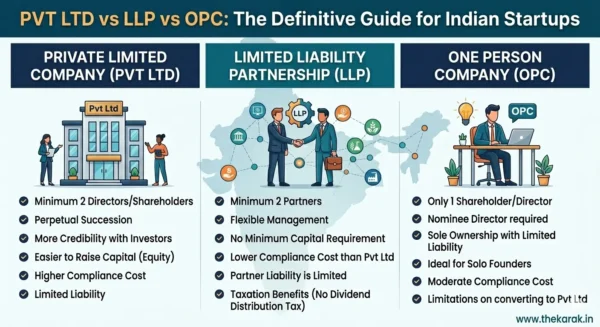
The Private Limited Company is the default structure for startups that intend to raise external capital, bring on co-founders with equity, or eventually scale. It is the structure investors are most familiar with, and the one that most Indian accelerators and VCs require before they will cut a cheque.
A Pvt Ltd gives the company a separate legal identity from its founders — which means the company can own assets, enter contracts, and be sued independently. This separation is genuinely valuable. It limits the personal liability of founders and creates a clean foundation for bringing in employees, advisors, and investors with equity.
The tradeoffs are real. A Pvt Ltd comes with mandatory annual compliance — Board resolutions, Annual General Meetings, ROC filings, audited accounts. For a two-person team in the first year, this overhead can feel disproportionate. It also requires a minimum of two directors and two shareholders, which means it is not suited to truly solo founders.
The LLP is a hybrid structure — it gives partners the limited liability protection of a company while keeping the flexibility and lower compliance burden of a partnership. It is well-suited to service businesses, consulting firms, and professional partnerships where the founders do not expect to raise equity from outside investors.
The critical limitation of an LLP for startups is this: you cannot issue equity shares. There are no shares, no shareholders, and no ESOPs. An LLP has partners with profit-sharing arrangements, not shareholders with equity stakes. This makes it incompatible with the standard structures that angel investors and VCs use to invest. Most investors will ask the company to convert to a Pvt Ltd before writing a cheque — and that conversion is possible, but adds time and cost.
Where an LLP genuinely shines is for professional services startups — design studios, legal tech firms, CA practices, consulting businesses — where the founders are the business, growth is steady and organic, and external equity is never part of the plan. The annual compliance is lighter, the profit distribution is more flexible, and the operational structure is less rigid.
The OPC was introduced precisely for solo founders who want the legal protection and credibility of a company without needing a co-founder or partner. It gives a single promoter a separate legal entity — the same protection from personal liability that a Pvt Ltd offers — while keeping compliance requirements relatively light.
The main constraints are worth knowing upfront. An OPC can have only one member and one director (the same person). It cannot raise equity funding from external investors in its OPC form. And once turnover exceeds ₹2 crore or paid-up capital exceeds ₹50 lakh, conversion to a Pvt Ltd becomes mandatory. In practice, this means an OPC is genuinely useful for the earliest stage of a solo venture — but any founder expecting to bring on co-founders or raise capital will need to convert.
For freelancers formalising into a business, first-time founders testing an idea solo, or consultants who want a company structure without a partner, the OPC is a sensible starting point. The conversion to Pvt Ltd later is straightforward if the need arises.
· · ·
Side-by-Side: How They Compare
| Factor | Pvt Ltd | LLP | OPC |
|---|---|---|---|
| Equity fundraising | ✓ Yes | ✗ No | ✗ No |
| Issue ESOPs | ✓ Yes | ✗ No | ✗ No |
| Solo founder option | ✗ Needs 2 | ✗ Needs 2 | ✓ Yes |
| DPIIT Startup India recognition | ✓ Yes | ✓ Yes | ✓ Yes |
| Annual compliance burden | Higher | Lower | Moderate |
| Foreign investment (FDI) | ✓ Permitted | Restricted | ✗ Not allowed |
| Separate legal identity | ✓ Yes | ✓ Yes | ✓ Yes |
| Profit distribution flexibility | Via dividends | Flexible | Via dividends |
The Decision in Plain Terms
If there are two or more founders and any possibility of raising external capital — from angels, VCs, accelerators, or even friends and family as equity — the Private Limited Company is the right choice. It is the only structure that allows for equity shares, ESOPs, and the kind of clean cap table that investors expect. The compliance overhead is real, but a good CA can handle it for ₹15,000–25,000 per year.
If the business is a service firm, a consulting practice, or a professional partnership — and equity fundraising is genuinely not part of the plan — the LLP is worth considering seriously. The lighter compliance load and flexible profit sharing are genuine advantages, and there is nothing wrong with building a profitable, sustainable service business without ever raising a round.
If founding solo and still in the “testing the idea” phase, the OPC offers a legitimate company structure without the requirement for a co-founder. But it is worth being honest about the ceiling: the moment a co-founder joins or an investor shows interest, conversion to Pvt Ltd becomes the path.
“The company structure is not permanent — it is the starting point. Most important is choosing something that does not close doors before the business even knows which doors matter.”
A Few Common Questions
Can an LLP be converted to a Pvt Ltd later?
Yes — conversion is legally possible under the Companies Act 2013. It involves filing with the Registrar of Companies, a fresh MoA and AoA, and reissuing share certificates. It typically takes 2–4 months and costs ₹15,000–40,000 in professional fees depending on complexity. It is doable, but adding this step later is slower and more expensive than starting with the right structure. If there is any genuine possibility of equity fundraising, starting as a Pvt Ltd is almost always the better call.
Does Startup India recognition apply to all three structures?
Yes. DPIIT recognition under the Startup India scheme is available to Pvt Ltd companies, LLPs, and registered partnership firms. This brings benefits including tax exemptions under Section 80-IAC, easier public procurement norms, and self-certification under labour and environmental laws. The recognition is tied to the entity being less than 10 years old and meeting the turnover threshold, not to the specific structure chosen.
What is the fastest way to register a Pvt Ltd in India?
The MCA21 portal allows Pvt Ltd registration through the SPICe+ form (Simplified Proforma for Incorporating Company Electronically). With all documents in order — DIN for directors, DSC, MoA, AoA, PAN and Aadhaar of founders — a CA or CS can typically complete registration in 7–15 working days. The government fees are modest; the main cost is the professional fee, which typically runs ₹6,000–15,000 for a straightforward incorporation.
Exploring this at The Karak
The Karak is a space where early-stage founders in India work through exactly these kinds of decisions — including the ones that come just before the company is formally registered. If this is something being thought through right now, it is a good place to compare notes with founders who have recently done the same.
Visit The Karak →Written by the team at The Karak — a space for early-stage founders in India to share real experiences, honest reflections, and the kinds of conversations that are hard to find elsewhere. This article is for informational purposes only and does not constitute legal or financial advice.