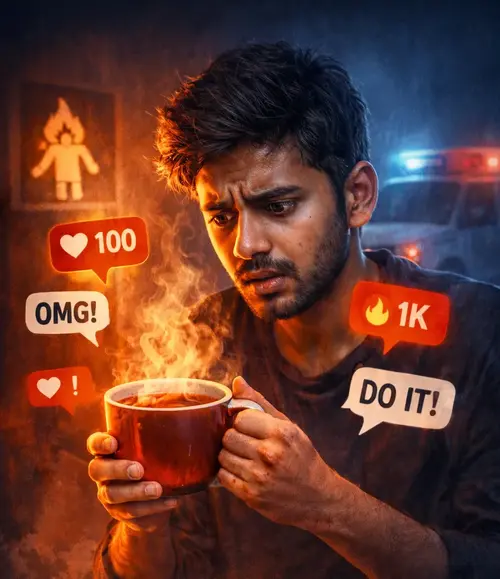

From the “Cinnamon Challenge” to the “Fire Paan” craze, social media feeds have long been a gallery of high-risk stunts. The latest trend making rounds—the Hot tea challenge—is no exception. While it might seem like a bit of fun for the “Gram,” the reality is far more scarring.
In this deep dive, we explore the hot tea challenge side effects doctor warning, and more importantly, the psychological itch that drives young Indians to exchange their physical safety for digital dopamine.
Hot tea challenge: The Medical Reality
Before we get into the why, we need to address the ouch. Medical professionals are seeing a rise in “social media injuries” in urban Indian clinics. When you consume or spill boiling liquids for a video, you aren’t just “testing your limits”—you are risking permanent damage.
Hot tea challenge side effects doctor warning signs include:
- Second and Third-Degree Burns: The delicate skin on the face and neck can scar permanently within seconds of contact with liquids above 60°C.
- Esophageal Perforation: Drinking scalding liquids can cause thermal injury to the throat, leading to long-term swallowing difficulties or even increased risk of esophageal cancer.
- Aspiration Pneumonia: If the heat causes you to gasp or choke, the liquid can enter the lungs, leading to severe infection.
“The human body isn’t built for viral stunts. We are seeing teenagers coming in with blistering burns that require skin grafts, all for a 15-second reel,” says Dr. Aniruddh, a general surgeon based in Mumbai.
Infographic: The Anatomy of a Viral Burn
| Body Part | Potential Damage | Long-term Consequence |
| Oral Cavity | Blistering of the tongue & palate | Loss of taste sensation |
| Esophagus | Thermal strictures (narrowing) | Difficulty eating solid food |
| Skin/Face | Deep tissue scarring | Expensive reconstructive surgery |
Why We Torture Ourselves: The Cultural Critique
In India, tea (Chai) is a symbol of community, comfort, and conversation. But the Hot Tea Challenge flips this cultural staple on its head. Why has “Karak” culture shifted from a cozy break to a dangerous dare?
1. The Currency of Validation
In a country with over 400 million Instagram and YouTube users, the competition for attention is fierce. For a young person in a Tier-2 city or a crowded metro, a viral video is a shortcut to “being someone.” When likes and comments are the primary currency, physical pain feels like a small price to pay for social capital.
2. The “Desi” Resilience Myth
There is a prevailing cultural sentiment in India that we are “tougher” than the rest. From eating the world’s hottest chillies to performing stunts on moving trains, there is a distorted sense of pride in enduring pain. The Hot Tea Challenge taps into this toxic bravado.
3. The Algorithm as a Puppet Master
The platform doesn’t care if you’re hurt; it cares if people are watching. Trends that trigger “shock and awe” are pushed to the top of the feed. This creates a feedback loop: Danger = Visibility = Validation.
Breaking the Cycle
The Karak vibe has always been about the community—the shared experience of a good brew. When we turn that experience into a hazardous stunt, we lose the very essence of why we gathered around the tea stall in the first place.
The Verdict
Your skin and your health are not “content.” They are your only home. No amount of heart emojis can fix a third-degree burn. Next time you see a “challenge” that involves fire, ice, or boiling liquids, remember: the trend will die in a week, but the scars stay for a lifetime.