

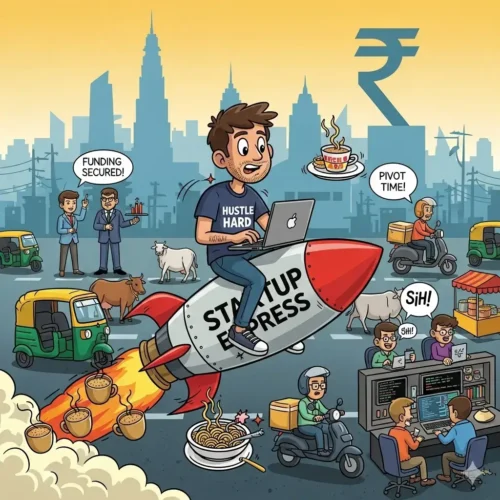
The Indian startup world is bouncing back. After a funding slowdown in 2022–23, things are moving again — not with huge mega-deals, but with lots of smaller and mid-sized ones. What’s exciting is that Indian investors are now playing a bigger role, and the focus is shifting toward meaningful areas like AI, semiconductors, climate and energy, health, fintech, and logistics. The government and private investors are both backing this wave.
Here’s a quick look at what’s happening and what to watch until 2030:
1. Funding is back (but looks different)
- Money raised: Indian startups pulled in about $13.7 billion in 2024 — a healthy jump from 2023.
- Recent activity: In Q2 2025 alone, ~$3.5B went into 355 deals.
- Startup count: Over 1.5 lakh startups are now officially registered with Startup India.
- Unicorns: India has around 110–120 unicorns, valued at nearly $400 billion.
👉 Bottom line: The frenzy of 2021 is gone, but funding is steady, with more diversity in deal size and sector focus.
2. Government focus = more opportunities
The government is moving from just “supporting startups” to building strong local products and manufacturing.
- Semiconductors & electronics: Big push with missions, subsidies, and new chip projects.
- Climate & energy: Incentives for EVs, batteries, and clean tech.
- Startup support: Grants, incubators, and training programs across 200+ centers.
👉 If you’re building in hardware, energy, or deeptech, this support could be a game-changer.
3. Sectors to watch (2025–30)
- AI & Generative AI → Tools for automation, local languages, healthcare, and more.
- Semiconductors & Electronics → Everything from chip design to manufacturing.
- Climate Tech → EV infra, batteries, clean energy.
- Healthtech → Medical devices, digital health platforms.
- Fintech → Payments, infrastructure, and B2B solutions.
- SaaS → Global software products made in India.
- Agritech & Logistics → Farming solutions, supply chain, warehousing.
4. How investors are behaving
- Most deals are small to mid-sized (seed to Series A/B).
- Indian investors (corporates, pension funds, insurance) are more active.
- Hot picks in 2025: AI, fintech, healthtech, logistics, and defence tech.
- Expect rising bets on climate tech and semiconductors as government support grows.
5. Risks to keep in mind
- Global market shocks could slow funding.
- Deeptech and hardware take longer and need skilled talent, which is still limited.
- New rules on data, AI, and fintech may create roadblocks.
6. Tips for founders & professionals
- Founders: Build products with strong IP, local language/data support, and link them to government schemes where possible.
- Investors: Mix short-term bets (SaaS, AI) with long-term bets (deeptech, hardware).
- Professionals: Upskill in AI, hardware, clean energy, and healthtech — these are where the jobs and opportunities will grow.
- Corporates & ecosystem builders: Collaborate with startups and expand beyond Tier 1 cities.
7. What 2030 could look like
By 2030, India won’t just be known for software services. Expect a diverse startup ecosystem with strong home-grown products in chips, healthcare, batteries, and more. Government push + investor interest = a fertile ground for ambitious founders and professionals ready to dive in.
✨ In short: The Indian startup scene is entering a mature, opportunity-rich phase. It’s less about flashy mega-deals now, and more about building real, scalable businesses in areas that matter for India’s future.
Key sources:
- Bain & Company — India Venture Capital Report 2025 (funding rebound data, deal mix). Bain
- KPMG / industry quarterly reports — Q2 2025 VC trends (sector momentum, Q2 funding). The Economic Times+1
- Startup India / DPIIT — 9-Year Factbook & press releases (startup recognition counts, incubator numbers, govt funding flows). Startup India+1
- NASSCOM — DeepTech & GenAI mappings (deeptech & GenAI startup growth). NASSCOM+1
- India Semiconductor Mission / PIB releases (policy & incentive frameworks for chips/electronics). ism.gov.in+1