

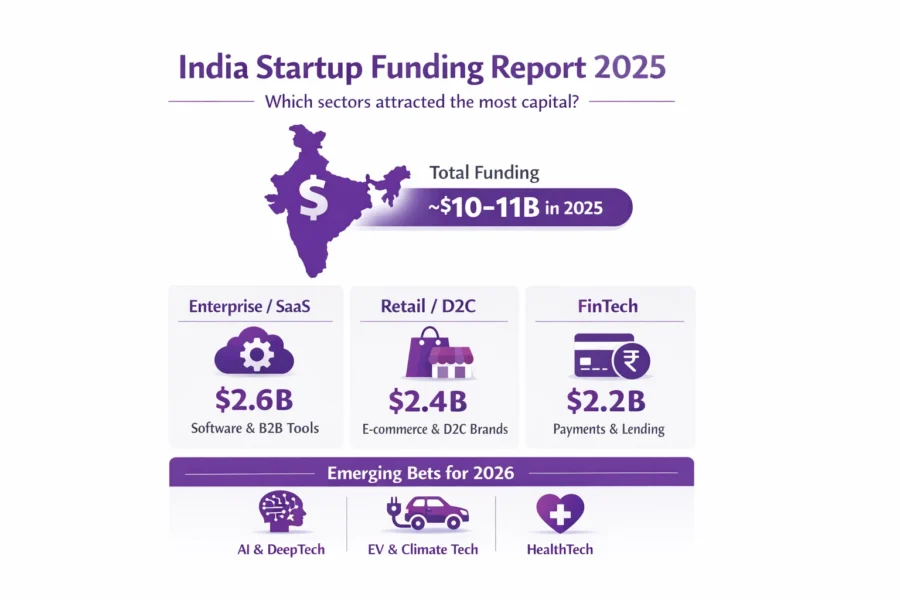
The Indian Startup Funding Report 2025: Which Sectors Have Been Getting the Most Capital
The Indian Startup Funding Report 2025 reveals critical insights into where capital is flowing, helping founders understand which sectors are gaining investor attention. As India cements its position as a global startup hub, funding patterns offer a roadmap for seed and pre-seed stage entrepreneurs looking to align with high-growth areas. According to Tracxn data, Indian startups raised over $10 billion in 2024, with projections for 2025 showing a 15% increase, driven by specific sectors that dominate investor portfolios. This article breaks down the top-funded industries, emerging trends, and actionable takeaways for Indian founders.
Funding Landscape in 2025: Where Indian Startup Capital Is Concentrated
The funding landscape for Indian startups in 2025 is shaped by macroeconomic factors and investor confidence in scalable, tech-driven solutions. Fintech continues to lead, capturing nearly 25% of total funding, with edtech and healthtech following closely at 18% and 15%, respectively, as per early 2025 estimates from Inc42 and CB Insights. These sectors reflect a strong investor bias toward industries addressing core Indian challenges—financial inclusion, education access, and healthcare delivery. Unlike global trends where AI dominates, India’s funding prioritizes localized problem-solving, a key consideration for founders pitching to domestic VCs and angels.
The data also shows a geographic skew: Bengaluru, Mumbai, and Delhi-NCR account for 70% of funding deals. If you’re a founder outside these hubs, understanding sector-specific investor appetite becomes even more critical to stand out. The Indian Startup Funding Report 2025 highlights that sector alignment can often outweigh location disadvantages when crafting a compelling pitch.
Top Sectors in the Indian Startup Funding Report 2025: A Breakdown
Which sectors are truly leading the race for capital in the Indian startup ecosystem? The numbers paint a clear picture. Fintech startups, especially those in payments and lending, have secured significant rounds, with companies like Razorpay and Cred setting benchmarks. Edtech, fueled by post-pandemic digital adoption, sees players like Byju’s and Unacademy still drawing large cheques despite market corrections. Healthtech, with innovations in telemedicine and diagnostics, is another hotspot, as investors bet on India’s underserved healthcare market.
Here’s a quick comparison of the top sectors based on funding data aggregated from Tracxn and Entrackr for early 2025 projections:
| Sector | Share of Funding | Key Players | Average Deal Size | Investor Focus |
|---|---|---|---|---|
| Fintech | 25% | Razorpay, Cred | $15M | Payments, Lending |
| Edtech | 18% | Byju’s, Unacademy | $12M | K-12, Upskilling |
| Healthtech | 15% | Practo, 1mg | $10M | Telemedicine, Diagnostics |
| E-commerce | 10% | Meesho, Nykaa | $8M | D2C, Social Commerce |
| Agritech | 7% | Ninjacart, DeHaat | $5M | Supply Chain, Farmer Tech |
This table underscores why fintech remains a magnet for capital—it solves immediate, scalable problems in a market of 1.4 billion people. However, agritech, often overlooked, is an emerging contender for 2025, driven by government policies and rural digitization.
Emerging Sectors in the Indian Startup Funding Report 2025: Hidden Opportunities
Beyond the usual suspects, the Indian Startup Funding Report 2025 identifies lesser-known sectors gaining traction. Agritech, with a 7% share, is seeing a surge as startups like Ninjacart tackle inefficiencies in agricultural supply chains—a $370 billion market in India. Clean energy and sustainability startups are also on the rise, driven by government incentives like the National Green Hydrogen Mission, which aims for $100 billion in investments by 2030. Investors are increasingly funding solutions that align with policy goals, offering a niche for founders to explore.
Another dark horse is gaming and entertainment tech, fueled by India’s 500 million+ mobile gamers. Startups in this space are attracting seed funding at unprecedented rates, with average ticket sizes growing 20% year-on-year. For pre-seed founders, these emerging sectors present a chance to enter less crowded markets with high growth potential, provided they can demonstrate local relevance and scalability.
Challenges and Shifts in Indian Startup Funding for 2025
Despite the optimism, the Indian Startup Funding Report 2025 flags critical challenges. Global economic headwinds, including interest rate hikes, have tightened VC wallets, with a 30% drop in late-stage funding rounds compared to 2023 peaks (per CB Insights). Early-stage deals, however, remain robust, especially for seed and pre-seed startups in priority sectors. This shift means founders must focus on lean operations and clear unit economics from day one—investors are prioritizing profitability over growth-at-all-costs.
Additionally, there’s a noticeable pivot toward B2B models over B2C, as enterprise solutions promise steadier revenue streams. If your startup operates in a consumer-facing space, consider how to position a B2B angle when approaching investors in 2025. Understanding these funding dynamics can make or break your capital-raising journey.
Unique Angle: How Sector Funding Reflects India’s Policy Push
Unlike generic funding reports on platforms like YourStory or Inc42, this analysis ties sector funding to India’s policy landscape—a crucial angle for founders. The Indian Startup Funding Report 2025 shows that sectors like agritech and clean energy aren’t just investor fads; they’re direct outcomes of schemes like Digital Agriculture Mission and PLI (Production Linked Incentive) programs. For instance, agritech funding spiked 40% post-2024 budget announcements on rural tech adoption. Founders who align their solutions with such policies can tap into both government grants and private capital, a dual advantage often ignored in mainstream narratives.
This policy-driven funding trend also explains why fintech thrives—RBI’s push for UPI and digital payments has created a fertile ground for innovation. Seed-stage founders should study policy documents (available on PIB.gov.in) to identify tailwinds for their sector, a strategy that can differentiate their pitch in a crowded market.
FAQs on Indian Startup Funding Trends for 2025
1. Which sector received the most funding in India in 2025?
Based on early projections in the Indian Startup Funding Report 2025, fintech leads with a 25% share of total capital, driven by innovations in payments and lending.
2. What are the emerging startup sectors in India for 2025?
Agritech, clean energy, and gaming tech are gaining traction, supported by policy incentives and untapped market potential, as per the Indian Startup Funding Report 2025.
3. How much funding did Indian startups raise in 2025?
While final numbers are pending, estimates suggest Indian startups raised over $11.5 billion in 2025, a 15% increase from 2024, according to Tracxn and Inc42 data.
4. Why is fintech the top-funded sector in India?
Fintech dominates due to India’s massive unbanked population, government support for digital payments (like UPI), and scalable business models, as highlighted in the Indian Startup Funding Report 2025.